Overview
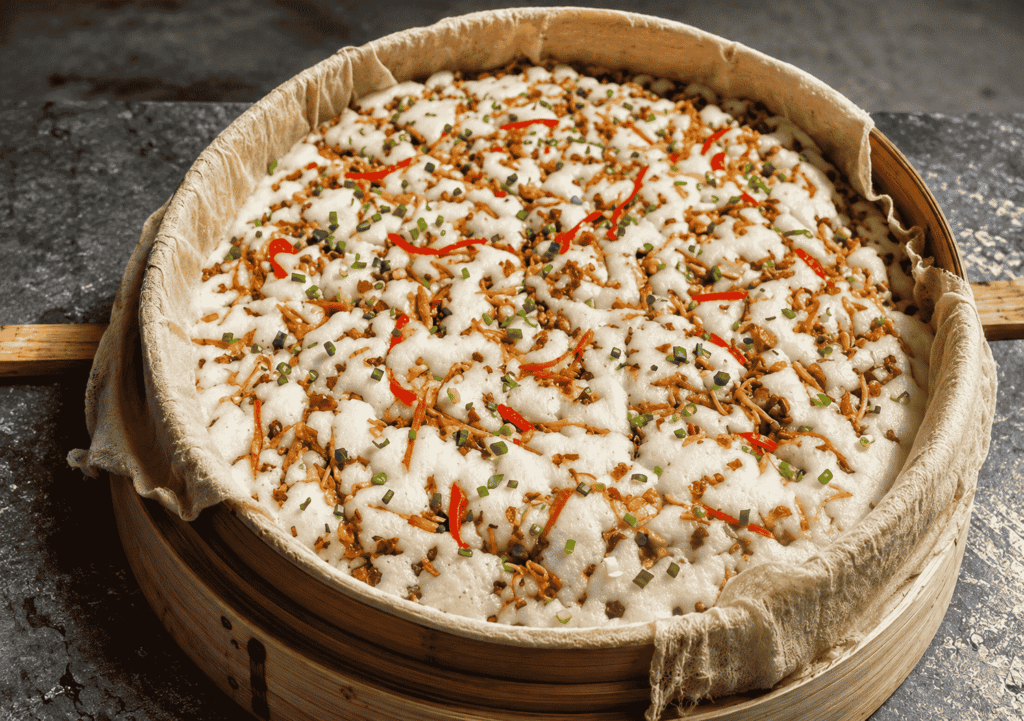
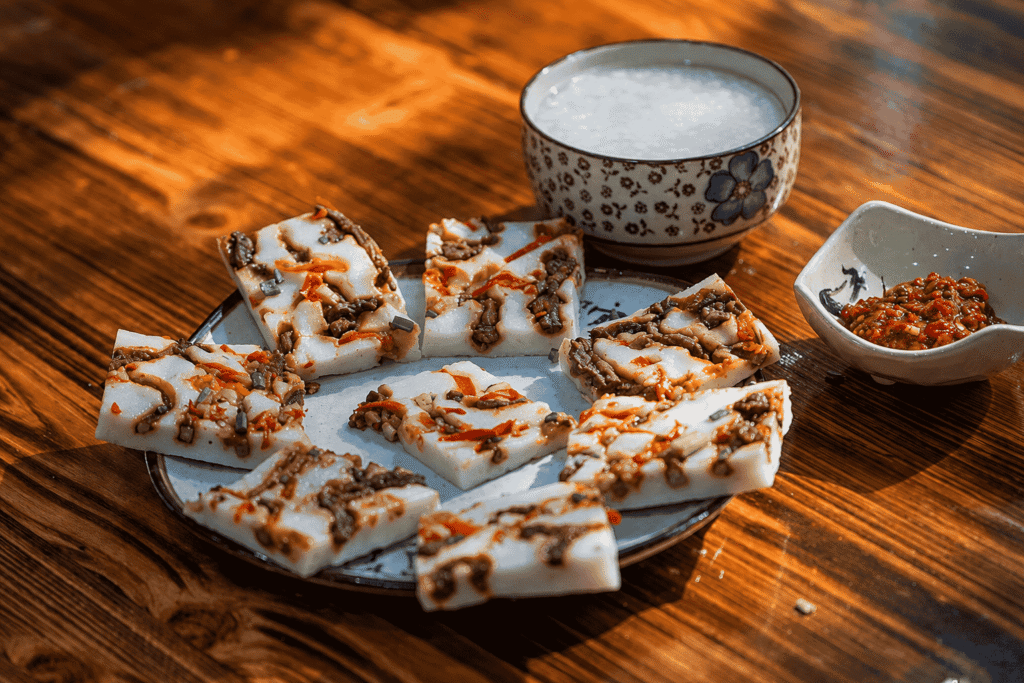
Changshan Pei Gao (常山醅糕) is a traditional steamed rice cake associated with Changshan County in Quzhou, western Zhejiang Province.[1][2][3][5] It is also known locally as qi gao guo (汽糕粿) or pei guo (醅粿).[2][5][7] The dish is made from a fermented rice batter that is spread in a shallow steaming tray, topped with selected ingredients, and steamed until soft and lightly elastic.[1][2][6]
Pei gao may be prepared in savory or sweet forms.[2][5] Savory versions commonly include ingredients such as pork, preserved vegetables, dried bamboo shoots, chili, scallions, or soy sauce, while sweet versions are generally seasoned with sugar and a small amount of cooking oil.[1][2][5][6] The precise combination varies between households, allowing the dish to reflect family preferences, seasonal availability, and locally available ingredients.[1][4][6]
Although traditionally associated with festivals, family gatherings, and other important occasions, Changshan Pei Gao is also widely eaten as a breakfast food or everyday snack.[1][2][3][4][7] Local accounts describe it as soft in texture, suitable for diners of different ages, and adaptable to a broad range of toppings.[1][2][3]
History and Regional Context
The Changshan County Gazetteer places the emergence of Changshan Pei Gao around the transition from the late Ming dynasty to the early Qing dynasty, roughly between 1628 and 1700.[5]
A county gazetteer is a locally compiled reference work that records the history, geography, customs, notable figures, education, products, and other aspects of a county. Covering the area’s natural environment as well as its political, economic, cultural, and social development, it is often described as a comprehensive local history or a local encyclopedia.
Rather than being attributed to a single inventor, the dish appears to have developed through household practice and oral transmission in the rural communities of Changshan and nearby areas of western Zhejiang.[1][4] Knowledge of its preparation was traditionally passed between generations, with families adjusting the batter, fermentation, toppings, and seasoning according to household preferences, available ingredients, weather conditions, and the characteristics of locally grown rice.[1][4]
In Changshan, pei gao has long been associated with important occasions in the traditional calendar. Local accounts describe families preparing it for the Dragon Boat Festival, the seventh lunar month or Ghost Festival, the Spring Festival, and other major seasonal or ceremonial gatherings.[1][2][3][4][7] In earlier periods, its labor-intensive preparation made it particularly suited to holidays, family gatherings, and hospitality. As household equipment and production routines changed, it also became more widely prepared and sold as a breakfast food and local snack.[1][2][3]
The dish is most strongly identified with Changshan County, although related steamed rice cakes are also found in neighboring Kaihua County and elsewhere in the Quzhou region.[5][7] Some local accounts claim that the Kaihua-style steamed cake developed from traditions carried outward from Changshan, but this transmission has not been firmly established through documentary evidence. It is therefore better treated as an element of local oral tradition rather than as verified history.[5][7]
Changshan Pei Gao has been recognized within Quzhou’s intangible cultural heritage protection framework.[4][8] This recognition reflects not only its preparation technique, but also its role in household celebrations, local hospitality, seasonal food customs, and collective memory. Today, pei gao continues to be sold in local breakfast shops and markets while also appearing in cultural promotion, heritage reporting, community events, and family meals.[1][3][4]
Ingredients and Components
Main Ingredients: Rice flour, medium-gluten wheat flour, starch, fermented rice lees, yeast, and water.
Additional Ingredients: Diced pork belly, water bamboo, dried shrimp, red bell pepper, corn oil, qianzhang tofu skin, and scallions.
Seasonings: White granulated sugar, salt, dark soy sauce, light soy sauce, oyster sauce, monosodium glutamate (MSG), huangjiu, and baking soda.
The preparation uses a mixed-flour batter rather than rice flour alone. The dry base consists of approximately 1,500 g of water-milled rice flour, 310 g of medium-gluten wheat flour, 80 g of tapioca starch, 80 g of wheat starch, and 30 g of soybean flour. Together, these ingredients form a dry-flour blend of about 2,000 g.
Calculated against the total dry-flour weight, the mixture contains approximately 75 percent rice flour, 15.5 percent wheat flour, 4 percent tapioca starch, 4 percent wheat starch, and 1.5 percent soybean flour. The combination produces a batter that retains the flavor of rice while gaining additional structure, cohesion, and elasticity from the wheat flour and starches.
The flour mixture is combined with approximately 500 g of fermented rice mash, 15 g of yeast, 2,000 g of water, 10 g of sugar, and 1–2 g of salt. The amount of water is roughly equal to the total weight of the dry-flour mixture, although the fermented rice mash contributes additional moisture. In summer, ice water is used instead of water at room temperature.[6]
Preparation and Technique
Fermented Rice Mash
The fermented rice mash is prepared separately before the main batter is mixed. Cooked rice is inoculated with a local rice-fermentation starter rather than a sweet rice-wine starter. The mash should generally be prepared one day in advance and used the following day.
Once fermented, the rice mash is processed in a high-speed blender in two cycles until finely broken down. The source specifically warns against preparing it several days too early, as extended fermentation changes the characteristic flavor of the finished pei gao.
The working notes also describe a larger fermentation batch made from approximately one and one-quarter cups of cooked rice with several pieces of rice starter, divided between two containers for fermentation. This quantity is said to be sufficient for a substantially larger batch of rice flour. These measurements reflect a practical household or workshop method rather than a fully standardized commercial formula.[6]
Batter Formation and Fermentation
The rice flour, wheat flour, tapioca starch, wheat starch, and soybean flour are combined with the blended fermented rice mash, yeast, water, sugar, and salt to form the steaming batter. The batter must be sufficiently fluid to spread evenly in the steaming tray while still retaining enough body to support the savory topping.
The use of both fermented rice mash and commercial yeast creates a dual fermentation system. The rice mash contributes the characteristic fermented-rice aroma, while the yeast helps produce a lighter and more aerated texture. Water temperature, ambient temperature, fermentation strength, and the consistency of the blended rice mash can all influence the final batter.
The available working formula does not specify a universal fermentation time for the completed batter. This suggests that the batter is judged partly by its expansion, aroma, and consistency rather than by a single fixed duration.[6]
Preparation of the Savory Components
The savory topping is prepared in separate components rather than being cooked as one mixed filling. Each ingredient receives a different degree of cooking so that it retains the desired texture during the later steaming stage.
Diced pork belly is fully stir-fried before use. A larger topping batch uses approximately 2 jin, or about 1 kg, of diced pork belly for roughly 5 jin of flour. It is seasoned with dark soy sauce, light soy sauce, salt, oyster sauce, minced garlic, huangjiu, sugar, monosodium glutamate, and a small amount of additional savory seasoning. The pork should be cooked through before it is placed on the batter.
Water bamboo is cut into fine strips and quickly stir-fried, but it is deliberately not cooked completely. Huangjiu is added during cooking, together with a small amount of dark soy sauce for color and a light seasoning of salt. The working notes give approximately 1.2 jin, or about 600 g, of water bamboo for a batch based on 5 jin of flour.
Dried shrimp or shrimp skin is also quickly stir-fried. The purpose is primarily to develop color and aroma rather than to cook it for an extended period. A small amount of huangjiu, dark soy sauce, salt, and sugar is used during this stage.
Red bell peppers are deseeded and cut into fine strips. Rather than being fully stir-fried in advance, the strips are tossed with corn oil so that each piece is lightly coated. This helps distribute the pepper evenly over the surface of the cake.
Qianzhang tofu skin is cut into thin strips and quickly stir-fried or tossed with dark soy sauce and a small amount of salt. Chopped scallions are prepared separately and mixed with a very small quantity of baking soda before use.[6]
Assembly Considerations
The topping components are prepared separately because they do not require the same cooking time. Pork is cooked through in advance, while water bamboo, dried shrimp, tofu skin, bell pepper, and scallions receive lighter treatment so that they do not become excessively soft after steaming.
The topping notes are scaled separately for approximately 5 jin, or 2.5 kg, of flour. They should therefore be understood as workshop-style batch guidance rather than as an exact one-to-one match with the 2,000 g dry-flour batter formula described above.
The final quality of Changshan Pei Gao depends on the balance between the fermented batter and the topping. The batter must be fluid enough to spread evenly but strong enough to hold the ingredients on its surface. The topping should be seasoned before assembly, but the individual components should retain enough texture to withstand the final steaming process.[6]
Typical Steps
-
Prepare the fermented batter.
Mix the flour blend, fermented rice mash, water, sugar, salt, and a small amount of oil until smooth. The batter should be pourable but thick enough for surface marks to remain briefly after stirring. -
Rest and ferment the batter.
Cover the batter and allow it to rest. Add the yeast, mix well, and continue fermenting until numerous small bubbles appear. In warm weather, refrigeration may be used to prevent excessive souring. -
Adjust the fermented batter if necessary.
Stir gently to release large air bubbles. If the batter has become noticeably sour, a few drops of Chencun kanshui, an edible alkaline water, may be added before mixing again. -
Prepare the savory toppings.
Cook the diced pork thoroughly. Lightly cook or season the water bamboo, dried shrimp, tofu skin, bell pepper, and scallions separately so that they retain some texture during steaming. -
Fill the steaming tray.
Lightly grease a shallow tray with corn oil, pour in an even layer of batter, and gently tap the tray to release large trapped bubbles. -
Add the toppings and proof briefly.
Spread the prepared toppings evenly over the batter. Leave the assembled cake briefly until small bubbles appear and the batter has expanded slightly. -
Steam the cake.
Place the tray in a steamer only after the water has reached a full boil. Steam over high heat until the batter is fully set, then remove the lid promptly. -
Finish and serve.
Brush the hot surface with a lightly seasoned soy-oil mixture. Allow the cake to cool slightly before removing it from the tray and cutting it into pieces. Leftovers may be frozen, thawed overnight in the refrigerator, and pan-fried with oil the following day.[6]
Variations
Pei gao can be prepared in both savory and sweet forms. Savory versions may contain pork, bamboo shoots or water bamboo, dried shrimp, tofu skin, peppers, preserved vegetables, or beans. Sweet versions generally rely more heavily on sugar and oil.[5]
Sources
舌尖上的常山丨常山醅糕 — 常山旅游 / Sohu
published September 16, 2020.
舌尖常山|2023中国山地自行车公开赛(浙江·常山站) — 北京旅游网
based on materials from Changshan cultural and tourism sources.
常山芳村镇:感受千年宋镇风貌,体验非遗文化传承 — 杭州日报 / 杭州网
published October 3, 2020.
在传承中发扬——胡家醅糕 — 《今日常山》. Accessed 2026-06-12
published July 1, 2023.
常山醅糕 — Baidu Baike
used as a secondary reference for the dish’s names, historical background, and general description.
常山醅糕 Changshan Pei Gao — Xiachufang
a user-submitted recipe used as a practical reference for ingredients, fermentation, steaming, and reheating methods.
江西“最美最好吃”的铁路明天正式通车了 — Ifeng
published December 27, 2017, and used as an auxiliary reference for the dish’s regional distribution, local names, and festival associations.
浙江常山县特产有哪些? — 中国惠农网
published July 8, 2022, and used as an auxiliary reference for Changshan food culture and intangible-cultural-heritage claims.