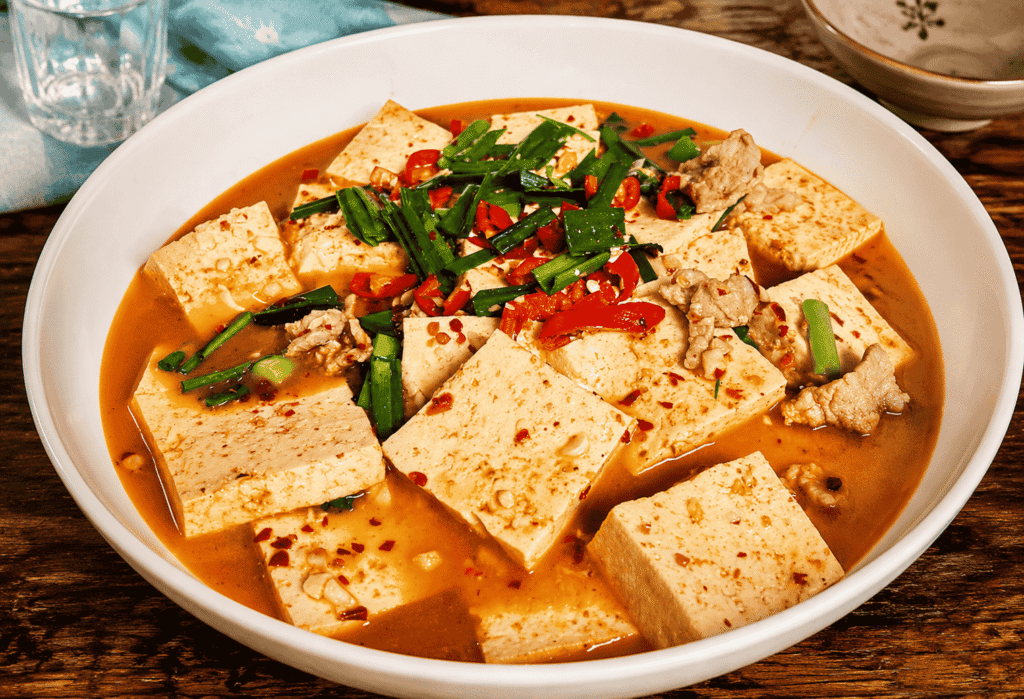

Overview
Qiuchuan tofu is a traditional tofu food closely associated with Qiuchuan Town in Changshan County, Zhejiang. The Baidu Baike page describes it as a traditional specialty of Qiuchuan Town and one of the “Three Treasures of Qiuchuan.” The same page also notes that Qiuchuan Town has been described as a leading tofu-producing town in Zhejiang. [6] Compared with an ordinary tofu dish, Qiuchuan tofu is defined not only by its cooking method but also by the local conditions and craft behind the tofu itself. Public sources emphasize the use of ancient well water and mountain-grown soybeans, processed through traditional handcraft, producing a tofu with a delicate, smooth texture, a fresh and tender mouthfeel, and a pronounced soybean aroma. [6] For this reason, Qiuchuan tofu should not be treated simply as “tofu cooked with pork” or as a generic spicy tofu dish. In a Yummism entry, it is more accurately understood as a regional tofu food centered on locally made Qiuchuan tofu, with multiple culinary uses and cooked preparations built around that local product. [1][2][6]
History and Regional Context
The regional identity of Qiuchuan tofu comes first from Qiuchuan itself. Public descriptions often connect the tofu with ancient well water, mountain-grown soybeans, and hand-grinding, presenting these local conditions as part of the food’s distinctive texture and soybean aroma. [1][2][6] A recurring local story connects Qiuchuan tofu with Wang Yingchen, a Southern Song official and poet. Both the Baidu Baike page and local food materials mention that Wang Yingchen, during his youth, had connections with Qiuchuan in Changshan and was said to have enjoyed the area’s fresh and tender clear-braised tofu. This should be presented as a local food legend or cultural memory rather than as a fully verified historical fact. [1][6] From the perspective of transmission and heritage, the Baidu Baike page states that the traditional production technique of Qiuchuan tofu was included in the Quzhou municipal intangible cultural heritage protection list in 2008. This detail is important because it links Qiuchuan tofu not only to a local dish but also to the preservation of traditional food craftsmanship in Changshan. [6] The Baidu Baike page further places Qiuchuan tofu within contemporary local food promotion, including the “Changshan Ten Bowls” and Quzhou cuisine contexts. When read together with Zhejiang’s Bai Xian Qian Wan food-branding program, Qiuchuan tofu appears to have moved from township foodways and household cooking into a broader provincial framework of regional cuisine and cultural tourism. [3][4][6] Qiuchuan tofu can therefore be understood as a Changshan tofu food with domestic, local, and cultural-tourism significance. Its identity is connected with local water sources, mountain soybeans, traditional tofu-making, Changshan’s fresh-spicy flavor profile, and Zhejiang’s contemporary regional food branding. [1][2][3][6]
Ingredients and Components
Qiuchuan tofu is not limited to a single prepared dish. It refers more broadly to a group of tofu products made through local methods in Qiuchuan. The Baidu Baike page notes product forms such as white tofu, dried tofu, tofu sheets, and tofu pudding. [6] When Qiuchuan tofu is cooked as a hot dish, it is often paired with meat, chilies, and aromatics. Local materials mention local pork, salt, chili, rice wine, scallion, ginger, and garlic. The video version provided by the user uses Qiuchuan tofu, pork belly, red pepper, garlic shoots, camellia oil, light soy sauce, dark soy sauce, salt, oyster sauce, chili powder, and water. [1][5][6] This combination creates a dish with soybean aroma, meat fragrance, soy-sauce savoriness, and a fresh-spicy edge. The tofu provides the soft central texture, pork belly contributes fat and meat aroma, chili or chili powder reinforces Changshan’s fresh-spicy profile, while garlic shoots and red pepper add fragrance and color. [2][5][6]
Preparation and Technique
From the tofu-making perspective, the Baidu Baike page emphasizes the traditional handcraft aspect of Qiuchuan tofu, including steps such as selecting soybeans, soaking them, grinding, boiling the soybean milk, coagulating the curds, and forming the tofu. This information is useful for explaining that the core identity of Qiuchuan tofu lies not only in how it is cooked but also in how the tofu itself is produced. [6] From the dish-cooking perspective, the video shows a combined technique of stir-frying, pan-frying, and short braising. Pork belly is first stir-fried in camellia oil to release aroma and fat; the tofu is then added and pan-fried until both sides turn golden; seasonings and water are added afterward so that the tofu can simmer and absorb the meat aroma, soy-sauce savoriness, and chili flavor. [5] For the Yummism entry, it is useful to distinguish two layers of technique: first, the traditional craft of making Qiuchuan tofu itself; second, the local hot-dish preparation that uses Qiuchuan tofu as its main ingredient. The first layer reflects regional food craftsmanship, while the second reflects Changshan’s fresh-spicy cooking style and household culinary practice. [2][5][6]
Typical Steps
1. To make Qiuchuan tofu itself, the traditional process usually includes selecting soybeans, soaking them, grinding them, boiling the soybean milk, coagulating the curds, and forming the tofu. The Baidu Baike page presents these as part of the traditional production technique of Qiuchuan tofu. [6]
2. Cut the prepared Qiuchuan tofu into large square pieces, keeping the pieces intact so that they can withstand pan-frying and simmering. [5]
3. Slice the pork belly, cut the red pepper into diamond-shaped pieces, and cut the garlic shoots into sections. [5]
4. Add camellia oil to a hot wok or pan, then stir-fry the pork belly until it releases fat and turns lightly browned. [5]
5. Add the tofu pieces and gently pan-fry them until the surfaces become golden. [5]
6. Season with salt, light soy sauce, dark soy sauce, oyster sauce, and chili powder, then add an appropriate amount of water. [5]
7. Simmer the tofu for about 6 to 8 minutes, allowing it to absorb the meat aroma, soy-sauce savoriness, and fresh-spicy flavor. [5]
8. Add garlic shoots and red pepper shortly before serving to brighten the aroma and color of the finished dish. [5]
9. Transfer the tofu, pork slices, and sauce into a shallow pot or small serving vessel and serve hot. [5]
Variations
Qiuchuan tofu does not refer only to one fixed cooked dish. It can also refer to a range of traditional tofu products from the Qiuchuan area. The Baidu Baike page mentions white tofu, dried tofu, tofu sheets, and tofu pudding as product forms associated with Qiuchuan tofu. [6] In culinary use, Qiuchuan tofu may be prepared in clear-braised, meat-braised, pan-fried, or spicy simmered forms. Local materials also suggest that it can be cooked with or without meat. [1][5][6] For Yummism, Qiuchuan tofu is therefore best treated as a regional tofu food rather than as a single fixed recipe. The entry can explain that Qiuchuan tofu is both a traditional local tofu product and the basis for several prepared dishes, including clear-braised versions and richer versions cooked with pork belly, chili, garlic shoots, and sauce. [1][5][6]
Sources
Poetic Zhejiang · A Hundred Counties, A Thousand Bowls: Changshan Ten Bowls (Part Two) — Sohu / Reposted local Changshan food material
This source describes Qiuchuan tofu as a local Changshan dish made with tofu from Qiuchuan Ancient Town, along with local pork, chili, rice wine, salt, scallion, ginger, and garlic. It also describes the tofu as having a strong soybean aroma and a fresh, mild flavor, and records a local story connecting Qiuchuan tofu with Wang Yingchen.
The Chinese City with the Freshest and Spiciest Flavor Is Not Chongqing or Changsha — China News Service Zhejiang
This source explains Changshan’s fresh-spicy food style and mentions that Qiuchuan tofu is made with ancient well water and mountain-grown soybeans through hand-grinding. It describes the tofu as delicate and smooth, and notes that local farm chili gives the dish a fresh and spicy character.
How Can Food, Accommodation, Travel, Shopping, and Entertainment Combine Everyday Appeal with Cultural Value? Chen Guangsheng Discusses the Creation of a Modern Song-Dynasty-Style Along the River During the Qingming Festival — Zhejiang Provincial Department of Culture and Tourism
Background on the "A Hundred Counties, A Thousand Bowls" program, food standardization, culinary branding, and the broader cultural context of Zhejiang tofu dishes.
Bai Xian Qian Wan Leads a New Food Trend as Zhejiang Launches a Food Culture Consumption Season — China News Service Zhejiang
Background on the Taste of Zhejiang · Bai Xian Qian Wan initiative and Zhejiang’s effort to build a regional food culture brand.
Changshan Qiuchuan Tofu Preparation Video — Changshan County Bureau of Culture and Tourism
This video shows a preparation of Changshan Qiuchuan tofu using Qiuchuan tofu, pork belly, red pepper, garlic shoots, camellia oil, soy sauces, salt, oyster sauce, chili powder, and water. It shows the tofu being cut, pan-fried, seasoned, simmered for several minutes, and served hot in a shallow pot. Use this source as internal editorial material until a stable public URL exists.
Qiuchuan DouFu — Baidu Baike
The screenshot provided by the user shows the Baidu Baike page describing Qiuchuan tofu as a traditional specialty food of Qiuchuan Town in Changshan County, one of the “Three Treasures of Qiuchuan,” made with ancient well water and mountain-grown soybeans through traditional handcraft. It also states that the traditional production technique was included in the Quzhou municipal intangible cultural heritage protection list in 2008. Use this source with caution and cross-check key claims where possible.